01
Your Body Keeps Interrupting Your Philosophy
You can believe you are a pure rational mind right up until you miss lunch.
Then the enlightened sovereign of your inner kingdom becomes furious at an email containing the word “circling.” Add poor sleep and a headache, and your timeless intellect may decide that everyone in traffic is personally collaborating against you.
The body keeps humiliating our theory that the “real me” lives somewhere behind the eyes while the rest is a damp vehicle with knees. We say my body the way we say my truck: useful, sometimes unreliable, definitely not the owner. Religion can make the split worse. We imagine death as the soul escaping its disgusting meat prison and heaven as the final cancellation of leg day.
That picture is not Catholic Christianity. It is closer to a pop version of Cartesian dualism with some inspirational fog added.
The Catholic claim is not that you are a ghost driving meat. It is that you are one living being—material and spiritual—whose body belongs to personal identity so deeply that Christianity ends not with permanent escape from the body, but with resurrection.
That claim does not erase the mind-body problem. It changes the starting point.
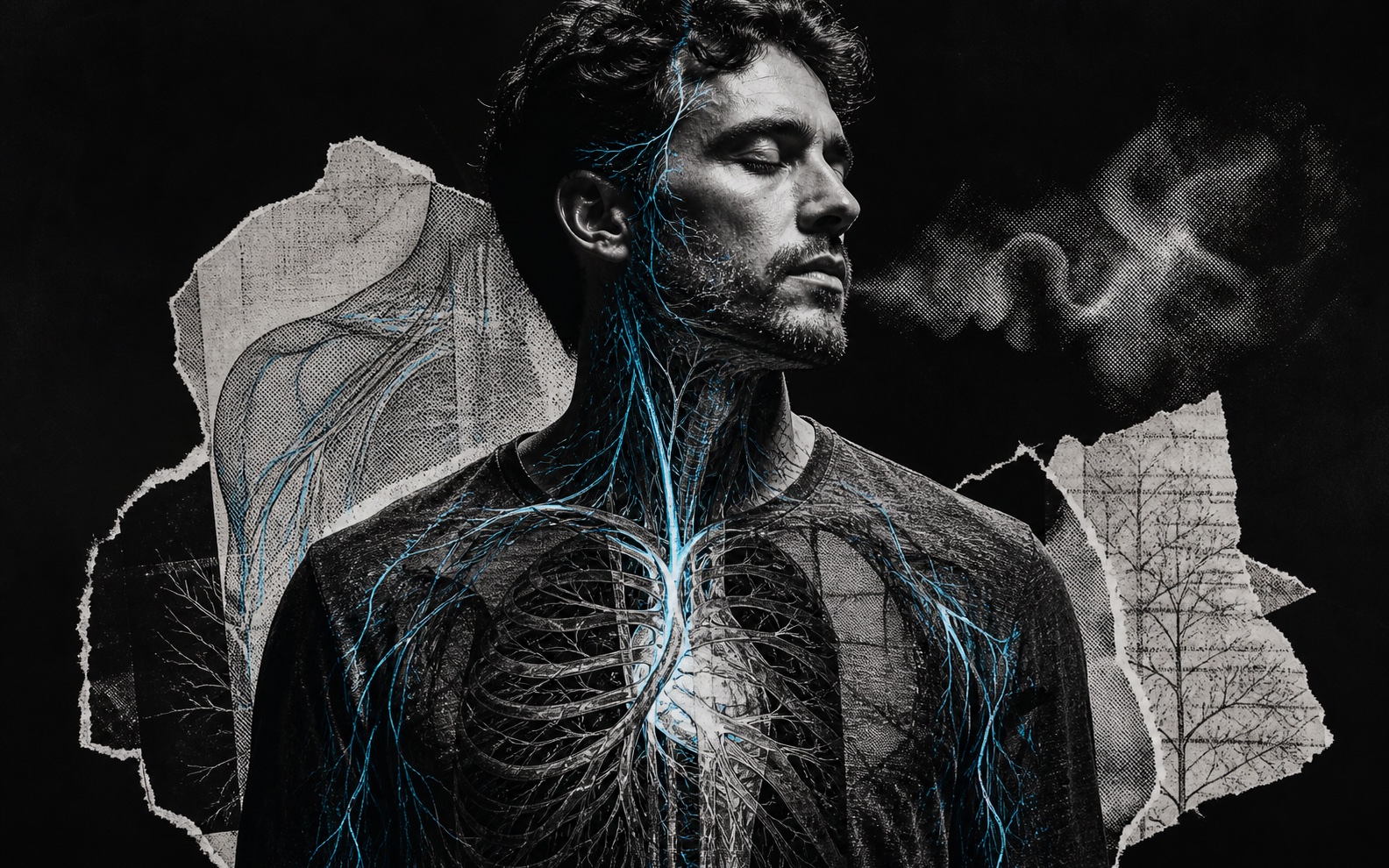
The body is not a vehicle the person owns. The body is the person made visible.
02
Three Rival Pictures of You
We need terms, because “soul” may currently mean anything from an immortal intellect to a playlist with excellent bass.
Substance dualism says mind and body are fundamentally distinct kinds of thing. In its strongest popular form, the mind is the real self and the body is a machine it occupies. René Descartes is the unavoidable name here, although actual philosophical positions are more careful than the internet cartoon.
Physicalism says everything about us is ultimately physical. There are many versions. Some identify mental states with brain states; others say consciousness emerges from physical systems without being usefully reducible to a simple neuron-by-neuron translation. Physicalism is not one argument, and anyone claiming to have defeated all of it in a three-minute reel should be tranquilized with a library card.
Hylomorphism—from Greek words for matter and form—begins with a living organism rather than two objects glued together. Aristotle called the soul the form of a living body: the organizing and animating principle by which this matter is alive as this kind of creature. Thomas Aquinas adapted that framework while arguing that the human intellectual soul has operations not exhausted by matter.
This does not make the soul a poetic word for DNA or complexity. Classical Catholic thought holds that the rational soul is spiritual and survives bodily death. But it is the soul of this body, not a complete human being who merely rented one.
03
The Evidence Is Embarrassingly Embodied
Contemporary science does not prove hylomorphism. It does, however, make the floating-pilot picture look increasingly silly.
Vision, touch, and proprioception—the body’s sense of its position—work together to generate bodily self-awareness. In the classic rubber-hand illusion, synchronized visual and tactile stimulation can make people experience an artificial hand as oddly belonging to them. The result does not prove that the self is an illusion. It shows that the felt boundary of the body is an active integration of sensory information, not a tiny spectator reading a dashboard.
Interoception adds the inside of the body to the story. The brain continually receives and predicts signals related to heartbeat, breathing, hunger, temperature, pain, and visceral state. Researchers debate the best models, but there is strong reason to reject the idea that emotion and thought happen in splendid isolation from bodily regulation. Feelings are not decorative emojis pasted onto reason; they involve the organism tracking what is happening to it.
Embodied-cognition research makes several claims of unequal strength. Some are well supported: cognition happens under real-time pressure, serves action, and often offloads work onto bodily and environmental structures. More ambitious claims—that the environment literally becomes part of the cognitive system, for example—remain disputed. “Embodied” is not a magic word that settles every problem.
The safe conclusion is substantial enough: human cognition as we observe it is the activity of a living, sensing, acting organism. We do not encounter a mind and then infer a body attached. We encounter embodied persons.
That matters beyond seminar rooms. Chronic pain can narrow attention. Sleep loss changes judgment. Trauma can register as bodily vigilance. Medication, hormones, breathing, movement, nutrition, and social touch can affect how the world feels. None of that makes love “just chemicals.” It means love is experienced by an animal, not downloaded into one.
04
The Strongest Objection: Damage the Brain, Damage the Person
Here is the hard objection to any spiritual account of the human being: alter the brain and you alter memory, temperament, inhibition, language, decision-making, even the apparent continuity of personality. Damage specific frontal systems and judgment can change dramatically. Anesthesia can suspend ordinary conscious awareness. Dementia can dismantle capacities families once treated as inseparable from the person they love.
Why posit an immaterial soul when the brain seems to do all the work?
That objection should hurt. Any theory of the soul that treats neurological devastation as an irrelevant scratch on the vehicle is morally obscene and empirically unserious. Brain dependence is real.
But dependence is not automatically identity. A damaged camera changes the image it produces; that analogy does not prove the mind is a separate photographer, but it shows why “damage changes performance” does not by itself settle what a power is. To move from neural dependence to “therefore all intellectual acts are nothing but physical processes” requires philosophical premises about matter, causation, universals, and explanation. Those premises may be defensible. They are not MRI results.
The hylomorphic answer is more integrated than the ghost model: of course brain injury affects personal activity, because the human person acts through bodily powers. Seeing requires eyes and visual systems. Remembering uses neural structures. Emotion recruits the whole organism. Aquinas did not have modern neuroscience, but his framework expects the embodied exercise of human capacities.
There is also an evidence limit on the Catholic side. Neuroscience cannot verify an immaterial intellect, personal survival after death, or resurrection. Those claims need philosophical argument and, for resurrection, revelation. A brain scan is neither a refutation nor a photograph of the soul.
05
The Catholic Claim: One Animal, Spiritual and Bodily
The Catechism calls the human person “at once corporeal and spiritual” and says the unity is so profound that soul is the form of the body. Spirit and matter are not two human natures in an awkward roommate arrangement. Their union forms one nature.
This changes several Christian conversations.
First, the body shares personal dignity. A body is not valuable only while beautiful, efficient, sexually desirable, cognitively sharp, or economically useful. The sleeping body, disabled body, addicted body, aging body, and dying body remain the bodily presence of someone—not failed packaging.
The body is not a vehicle the person owns. The body is the person made visible.
Second, bodily acts are personal acts. What we do with sex, food, work, violence, sleep, and attention cannot be sealed away from the “spiritual” self. This is why Catholic moral teaching can sound intensely physical. Sometimes it is expressed badly or enforced hypocritically. The underlying premise is not hatred of the body. It is that the body means something because the person means something.
Third, salvation is not evacuation. Christianity claims that God became flesh, that bodily acts can communicate grace, and that the final human hope is resurrection. A permanently disembodied soul would survive, on the classical account, but would not yet be a complete human being. Death is an enemy precisely because it ruptures a natural unity.
Finally, spiritual practices are bodily because people are. Catholics stand, sit, kneel, eat, fast, sing, wash, touch, anoint, and breathe words. None of those gestures mechanically manufactures holiness. They recognize that formation does not happen to a mind hovering six inches above the pew.
06
Stop Treating Yourself Like Cargo
You do not have to accept an immortal soul to notice the practical force of this view.
If you are embodied, exhaustion is not a moral failure—but pretending exhaustion has no moral consequences can be. Anxiety may contain an argument, a wound, a bodily alarm, or some combination. Care for the body is not automatically narcissism. Discipline is not automatically contempt. The goal is not worshiping the body or escaping it. It is learning to live as one person.
The Catholic claim goes further: your rational and spiritual life cannot be reduced without remainder to matter, yet your body is genuinely you. That tension is not a bug hastily patched by theologians. It is the doctrine.
A low-pressure next step: For one day, notice every time you say “my body” as though you were discussing a defective appliance. Replace one of those sentences with a more precise one: “I am tired,” “I am tense,” “I am hungry,” “I need movement,” or “I am in pain.” Then read paragraphs 362–368 of the Catechism. You are not required to agree. Just see whether the actual teaching resembles the ghost story you may have rejected.
Sources
Read further
The argument above is our own. These primary and reputable sources are here so you can inspect the evidence yourself.
- Stanford Encyclopedia of Philosophy, “Dualism”
- Stanford Encyclopedia of Philosophy, “Aristotle’s Psychology”
- Thomas Aquinas, Summa Theologiae, I, q. 76, a. 1, “The Union of Body and Soul”
- Catechism of the Catholic Church, §§355–384, especially §§362–368
- Matthew Botvinick and Jonathan Cohen, “Rubber Hands ‘Feel’ Touch That Eyes See,” Nature 391 (1998)
- Lisa Feldman Barrett and W. Kyle Simmons, “Interoceptive Predictions in the Brain,” Nature Reviews Neuroscience 16 (2015)
- Margaret Wilson, “Six Views of Embodied Cognition,” Psychonomic Bulletin & Review 9 (2002)
- Antoine Bechara and Martial Van der Linden, “Decision-making and Impulse Control after Frontal Lobe Injuries,” Current Opinion in Neurology 18 (2005)