01
Hunger is a terrible philosopher
By late afternoon on a fast day, the refrigerator has developed a personality.
It does not argue that food is good. That would be true and unnecessary. It argues that this particular desire is an emergency, that discomfort is an injustice, and that one handful of something crunchy would restore constitutional order.
Hunger narrows the world. So do nicotine, anger, lust, fear, the phone in your pocket, and the need to win a comment section against a stranger called PatriotWolf77. Appetite is not limited to food.
Catholic fasting places a small, voluntary interruption inside that reflex. It does not claim the body is bad. Christianity makes the outrageous opposite claim: God took a body, fed people, gave himself under the sign of food, and promises bodily resurrection. A practice that despised food would be badly aimed from the start.
The point is not to become a person who does not need food. The point is to become a person whose needs, desires, and freedoms have a truthful order.
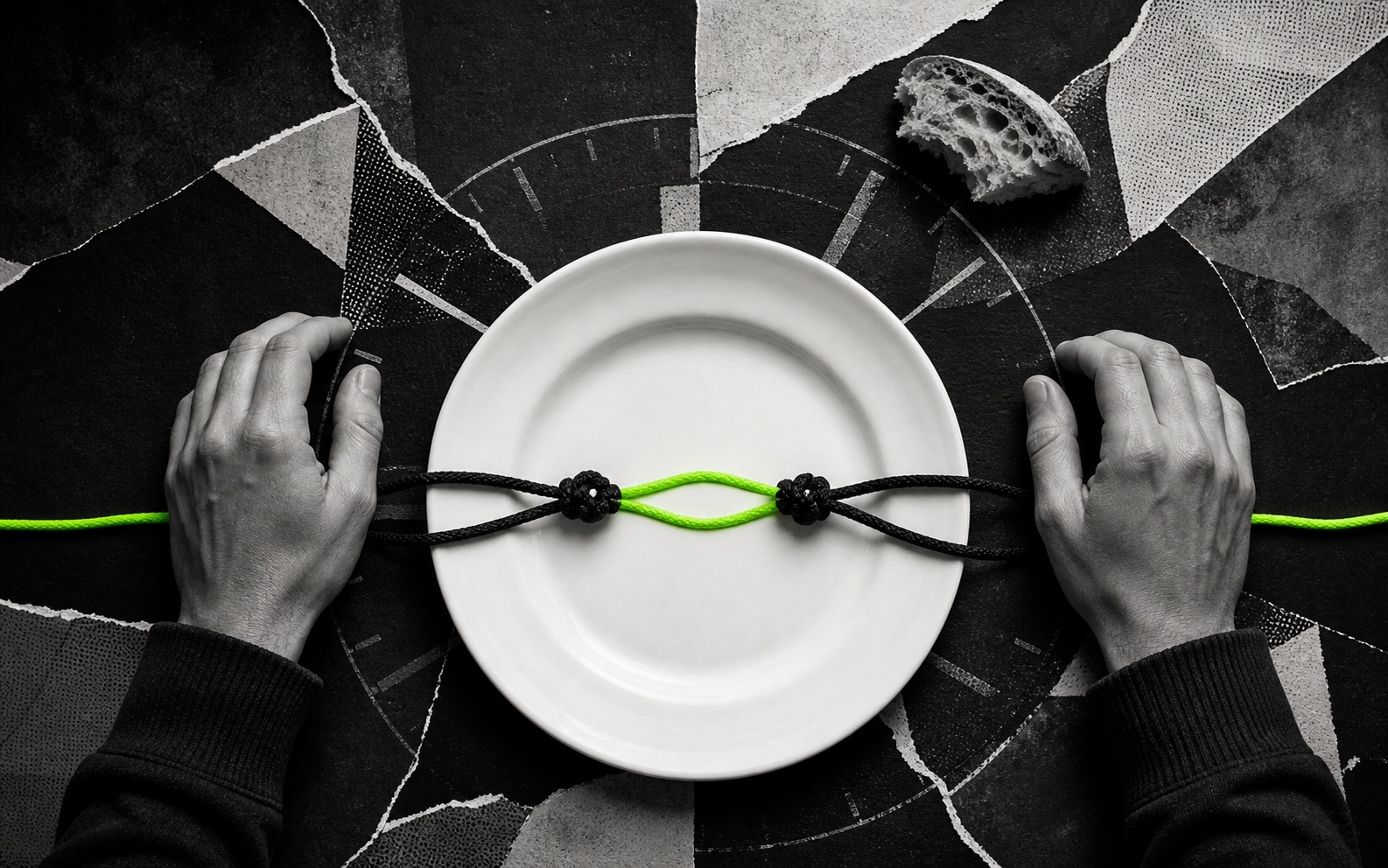
A Catholic fast is not contempt for food. It is a small mutiny against the idea that every appetite gets a vote and an immediate veto.
02
The strongest objection: diet culture wearing ashes
The strongest objection is that religious fasting can become diet culture with a crucifix.
People praise thinness as purity, turn restriction into competition, mistake control for virtue, and attach spiritual shame to medical or psychological realities. Fasting can be especially dangerous for someone with an eating disorder, a history of disordered eating, diabetes, pregnancy, nursing responsibilities, medications tied to meals, or another condition affected by food intake. A pious label does not neutralize a physiological risk.
There is also a theological objection. If God is good, why would God care whether somebody eats a sandwich? Does the creator of galaxies audit snacks?
No: God does not need your hunger. Catholic fasting is for the conversion of the person and the good of the neighbor. When it becomes self-harm, vanity, theatrical misery, or contempt for another person’s legitimate need to eat, it has contradicted its stated purpose.
That is why the Church’s minimum law is modest, why health exemptions matter, and why voluntary practices should not be imposed as a holiness scoreboard. “Harder” is not automatically “holier.” Sometimes it is simply harder—and occasionally dumber.
03
Four practices hiding under one word
The word fasting now covers several activities that should not be blended.
A canonical fast is the limited practice required by Church law on specified days for those it binds. In the United States, the Latin Catholic norm allows one full meal and two smaller meals that together do not equal another full meal.
A voluntary spiritual fast is a freely chosen restraint beyond that minimum: less food, simpler food, or sometimes another legitimate pleasure. Its Christian purpose is prayer, repentance, freedom, and charity—not weight loss.
Intermittent fasting is a dietary or clinical pattern that limits eating by time or day. It can be studied for metabolic or weight outcomes. It is not therefore prayer.
A hunger strike is sustained refusal of food used as protest or pressure. It raises distinct medical and moral questions about risk, coercion, witness, and responsibility. Calling it a fast does not make it the same practice as Lent.
04
What the Catholic Church actually requires
For Latin Catholics, the universal Code of Canon Law names every Friday and the season of Lent as penitential times. It requires fasting and abstinence on Ash Wednesday and Good Friday, while bishops’ conferences specify local practice.
In the United States, abstinence from meat binds Latin Catholics from age fourteen on Ash Wednesday and the Fridays of Lent. Fasting binds those ages eighteen through fifty-nine on Ash Wednesday and Good Friday. The U.S. bishops describe that fast as one full meal, with two smaller meals if needed that together do not equal a second full meal.
Those are minimums, not an elite training plan. The bishops explicitly excuse people outside the age limits and those who are physically or mentally ill, including people with chronic illnesses such as diabetes. Pregnant and nursing women are also excluded. Other serious health needs can matter; a pastor can also dispense or commute an obligation for a just cause under canon law.
Eastern Catholics follow the law and discipline of their own Churches, and rules differ across countries because episcopal conferences have authority to specify observance. An American infographic is not the universal constitution of lunch.
Voluntary fasting is a separate decision. It should be proportionate to health, responsibilities, and state of life. A parent caring for small children, a manual laborer, an older adult, and a healthy young desk worker may not prudently choose the same practice. Anyone with a medical condition, pregnancy, medication concern, or eating-disorder history should not improvise a food fast from an article. A clinician and a knowledgeable pastor are better guides.
The legal distinction is essential: the Church commands a small common act; she permits wider voluntary sacrifice; she does not command medical negligence.
05
The body science is interesting—and not the Gospel
Intermittent fasting has legitimate scientific interest. Researchers study time-restricted eating, alternate-day fasting, and whole-day patterns for weight and cardiometabolic effects. A 2019 review in the New England Journal of Medicine described plausible metabolic mechanisms and promising findings, while also noting the need for more long-term human research and clinical guidance.
Evidence has matured. A 2025 BMJ network meta-analysis reviewed 99 randomized trials involving 6,582 adults. Compared with continuous energy restriction, most intermittent-fasting strategies produced broadly similar effects on weight and cardiometabolic risk markers; alternate-day fasting showed a modest additional reduction in body weight. Studies varied, many participants had existing health conditions, and intermediate outcomes are not immortality.
More importantly, those protocols are not the Catholic fast. A metabolic study asks what a schedule does to measurable health outcomes. A Christian fast asks what voluntary restraint, joined to prayer and charity, does to love. The practices may overlap physically while differing in aim.
Catholic publishers should therefore resist baptized biohacking. Autophagy is not absolution. Ketones are not a charism. If a spiritual practice happens to carry a health benefit for a particular person, fine. The faith does not depend on the claim, and a person who is exempt for health reasons is not receiving a spiritually inferior Lent.
06
The freedom being trained
The Catechism places fasting beside prayer and almsgiving. The three point in different directions: prayer reorders us toward God, fasting reorders desire within the self, and almsgiving reorders goods toward the neighbor. Remove either of the other two and fasting can collapse into private performance.
The Bible is brutal about this. Isaiah 58 rejects fasting performed alongside exploitation and indifference to the poor. Jesus, in Matthew 6, tells people who fast not to advertise their misery. The practice is meant to become less theatrical and more just.
Fasting reveals how often “I want” quietly becomes “I must.” It creates a modest interval between desire and obedience. That interval is where freedom can grow.
But Christian freedom is not the ability to dominate one’s body. It is the ability to give oneself in love. The saved meal is supposed to become attention, money, food, or mercy for someone else. If skipping lunch makes a person cruel to everyone by 2 p.m., the first spiritual insight may be that the plan needs adjustment.
Food remains good. Feasting remains Christian. The same tradition that fasts before Easter spends fifty days celebrating it. Restraint serves communion; it is not the final destination.
07
One small, non-heroic next step
If you are not Catholic, Church fasting law does not bind you. If food restriction may be unsafe, do not use it as a spiritual experiment.
Try the logic without the danger: choose one unnecessary comfort for one day—a purchase, an hour of scrolling, the premium coffee, the need to have the last word. Pair the restraint with five minutes of honest prayer or silence and one concrete act of generosity. Do not post about it.
Then ask a less glamorous question than “Did I optimize?” Ask: “Did this make more room to love?”
Sources
Read further
The argument above is our own. These primary and reputable sources are here so you can inspect the evidence yourself.
- Code of Canon Law, canons 1249–1253 — days of penance, fasting, and abstinence
- United States Conference of Catholic Bishops — Lenten Fasting and Abstinence rules and exemptions
- Catechism of the Catholic Church, §§1434–1438 — fasting, prayer, almsgiving, and penance
- Catechism of the Catholic Church, §§2041–2043 — the precepts as an indispensable minimum
- Matthew 6:16–18 — teaching about fasting, USCCB Bible
- Isaiah 58 — fasting and justice, USCCB Bible
- de Cabo and Mattson, “Effects of Intermittent Fasting on Health, Aging, and Disease,” New England Journal of Medicine (2019)
- Semnani-Azad et al., “Intermittent fasting strategies and cardiometabolic risk factors,” BMJ systematic review and network meta-analysis (2025)