01
The bell does not ask about your mood
In a monastery governed by a Benedictine rhythm, the bell interrupts whatever story the ego was telling.
It is time to pray. Or work. Or read. Or eat. Or stop speaking. The day is not assembled from whatever feels meaningful in the moment. It has a shape received in advance.
Athletes recognize the insult. Training also arrives without consulting inspiration. The bag still needs rounds. The feet still need drills. The recovery day remains part of the program. You do not become capable by having unusually sincere intentions about tomorrow.
That is the narrow sense in which monks train like fighters. Both submit desire to repeated practice within a rule.
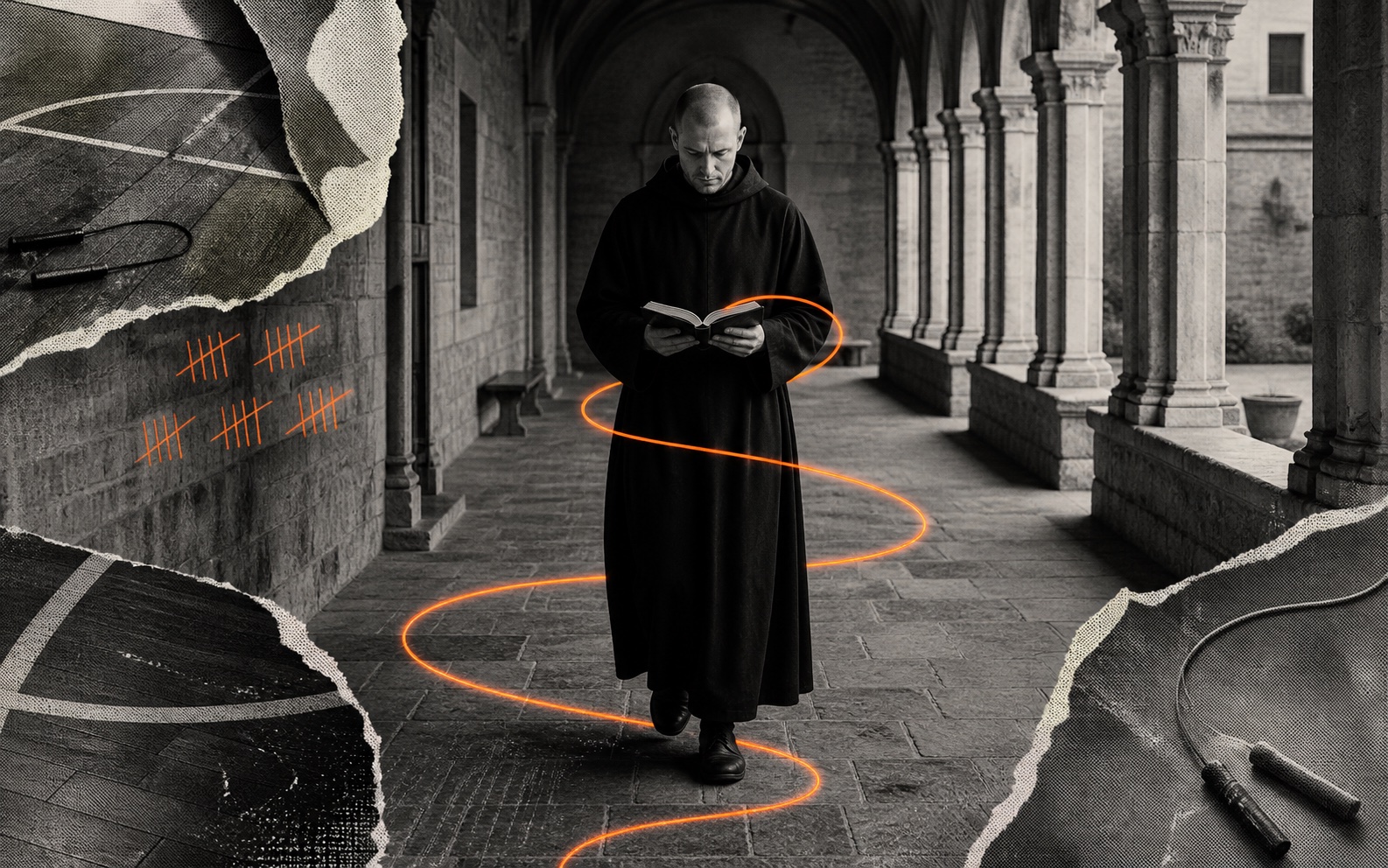
But the analogy can go bad almost instantly. Add dramatic lighting, a shaved head, and one quote about warfare, and the monk becomes a spiritual action figure—a celibate commando who has escaped softness, women, Wi-Fi, and apparently joy. This tells us more about the internet than about a monastery.
So keep the comparison, but make it behave.
A monk is not a spiritual action hero. He is a person who has arranged his life so that excuses have fewer places to hide.
02
The strongest objection: this is masculine clickbait
Monastic life is not a toughness brand.
Women have lived monastic life from Christianity’s early centuries and continue to do so. Not every religious is a monk or nun; Catholic religious life includes many active communities with different missions. Not every monk follows the Rule of Benedict. Some monastics live in community, some in greater solitude, and schedules vary by tradition and house.
More importantly, a fighter trains to perform under pressure against an opponent. A monk does not enter a monastery to accumulate spiritual wins. Prayer is not a performance metric, God is not a coach withholding a contract, and grace is not a trophy earned through volume.
Religious discipline has also been misused. Obedience can be distorted into control. Silence can conceal abuse. Communities can become unhealthy; leaders can fail. A romantic account that treats every command as holy because a person in robes gave it is not Catholic seriousness. The Church’s own law and teaching place religious authority inside a rule, constitutions, conscience, sacramental freedom, and service.
The comparison survives only if it remains an analogy about formation—not an excuse to turn monks into masculine-superhero props.
03
What monastic “training” actually means
A monk or nun is a man or woman who lives a form of Christian monastic life ordered to seeking God through prayer, community or solitude, ascetic discipline, and a received rule. In a Benedictine community, profession centers on stability, conversion of life, and obedience.
A rule is not a folder of life hacks. It is an architecture for a shared life: worship, Scripture, work, meals, sleep, possessions, hospitality, decision-making, correction, care for the sick, and treatment of weakness. Saint Benedict called his monastery a “school for the Lord’s service.” A school assumes nobody arrives finished.
Asceticism means embodied practice that trains desire for the good. It includes fasting, vigilance, chastity, silence, service, and renunciation. Christian asceticism does not purchase God’s love. It is a response to grace meant to make love less theoretical.
The Rule of Benedict is startlingly concrete. It schedules communal prayer across the day. It orders periods of sacred reading and manual labor. It tells the community to receive guests as Christ, pay special attention to the poor, care for the sick, moderate demands for the weak, and endure one another’s limitations with patience.
This is not one heroic man alone in a cave defeating his lower self. It is a community discovering, repeatedly, that the person ringing the bell, serving the kitchen, arriving late, singing off-key, or needing extra care is part of the path to God.
04
Rules beat vibes
Modern habit research cannot prove monastic theology, but it helps explain why a rule changes behavior.
Psychologists Wendy Wood and Dennis Rünger describe habits as responses strengthened through repetition in recurring contexts. Deliberate goals still matter, but stable cues and repeated action reduce the need to renegotiate every behavior from zero. The environment begins carrying part of the decision.
That is what a monastery does with unusual thoroughness. Place, time, sound, clothing, community, authority, and sequence all cue a way of life. The bell does not create love automatically. It makes showing up less dependent on novelty.
There is no magic twenty-one-day transformation. A 2024 systematic review of health-related habit formation found enormous variation: studies reporting time to automaticity ranged from four to 335 days, with medians around 59 to 66 days, and many studies had high risk of bias. Repetition matters; people are not identical machinery.
Sports research offers a second correction. A meta-analysis found deliberate practice explained a meaningful but limited portion of variation in athletic performance—about 18 percent overall and much less among elite performers. Practice is powerful. It is not the whole person, and it does not control every outcome.
Monastic wisdom would agree. A rule can dispose a person toward attention and fidelity. It cannot manufacture holiness. Temperament, health, history, community, leadership, freedom, suffering, and grace remain real.
05
Where the fighter analogy works—and where it taps out
The analogy works in limited ways. Both athletes and monastics accept that desire must be educated. Both repeat fundamentals after the romance disappears. Both need correction, rest, humility, and a community that sees what the individual misses. Both learn that freedom is not the absence of form but the capacity to act well under pressure.
Then the analogy breaks.
Even Benedict’s martial language points away from domination. The Rule’s final picture of good zeal asks monastics to honor one another, bear patiently with weakness, seek another’s benefit over their own, practice mutual obedience, and prefer nothing to Christ. The alleged warrior keeps getting assigned to the dish room.
This is why monastic discipline should look more human over time, not less. If the practice produces contempt for ordinary people, obsession with purity, or delight in control, the formation has gone crooked.
06
The target is love, not control
Catholic teaching describes religious life as a whole-person gift to God lived in common under vows. Prayer is central, but it is not escape. Vatican II’s decree on religious life joins contemplation to apostolic love and insists that common life, work, poverty, and service belong within the vocation’s shape.
The monastery tests spiritual claims against the person at the next choir stall. It is easy to feel universal compassion in solitude. It is harder when someone borrowed the tool, missed the cue, or has told the same story for seventeen years.
Stability removes the fantasy that salvation is waiting in the next city, community, job, relationship, app, or personal reinvention. Obedience challenges the claim that private preference is the final court of appeal, while legitimate authority remains accountable to truth and the community’s law. Conversion of life says formation is not an event but a direction renewed in ordinary acts.
None of this makes monastic life a universal prescription. Most Christians are called to families, professions, neighborhoods, and forms of service outside a cloister. The monastery matters partly because it makes one claim visible for everyone: what we repeatedly do with our bodies, attention, possessions, and time forms what we are able to love.
The fighter analogy gets us to the door. Grace, community, and charity take us inside.
07
Borrow the rhythm, not the costume
Do not buy a robe. Do not design a heroic 4 a.m. routine that will be dead by Thursday.
Choose one small rule for seven days: five quiet minutes at the same time; one Psalm before the phone; one meal without a screen; one hidden act of service; one fixed bedtime. Tell one trusted person what you are trying. If you miss, resume at the next cue instead of staging a trial about your character.
Then ask what the practice is making easier to love. That is a more monastic question than “Am I winning?”
Sources
Read further
The argument above is our own. These primary and reputable sources are here so you can inspect the evidence yourself.
- Order of Saint Benedict — Rule of Benedict: Prologue and opening chapters; daily manual labor, chapter 48; hospitality, chapter 53; profession, chapter 58; good zeal, chapter 72
- Second Vatican Council — Perfectae Caritatis, Decree on the Adaptation and Renewal of Religious Life
- Code of Canon Law, canons 607–709 — religious institutes, common life, prayer, and obligations
- Pope Francis — Apostolic Letter to All Consecrated People (2014)
- Wood and Rünger, “Psychology of Habit,” Annual Review of Psychology (2016)
- Singh et al., “Time to Form a Habit,” systematic review and meta-analysis (2024)
- Macnamara, Moreau, and Hambrick, “The Relationship Between Deliberate Practice and Performance in Sports,” meta-analysis (2016)